


PROJECT OVERVIEW
Sonochemistry: Engineering Molecules via Acoustic Cavitation
PROJECT DETAILS
- Research Name Sono-chemistry
- Category Process
- Location Vilnius, Lithuania

Advanced Sonochemistry: The Physics of Acoustic Cavitation
Beyond Mixing: Sonochemistry is not just agitation; it is a distinct state of matter interaction where sound waves drive chemical reactivity through thermal and physical mechanisms.
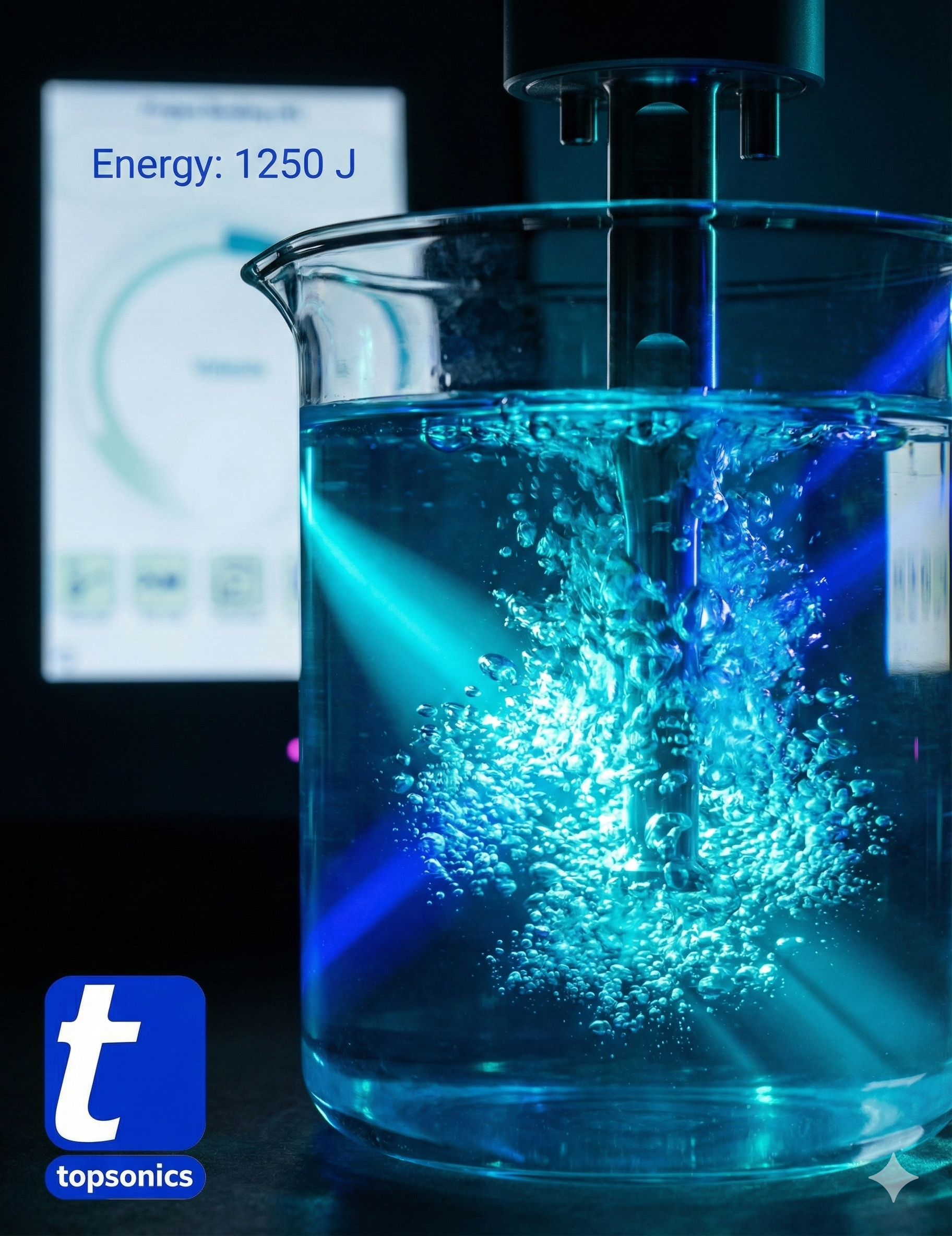
1. The Science: Inside the Acoustic Micro-Reactor
The utilization of high-intensity ultrasound in fluid processing represents a paradigm shift from macroscopic mechanical mixing to microscopic energy manipulation. In the realm of sonochemistry, we are not simply moving fluids; we are tearing them apart to access high-energy chemical pathways that are otherwise inaccessible under ambient conditions.
1.1 The Physics of the Hot Spot
At the heart of every sonochemical reaction lies the phenomenon of acoustic cavitation. When our 20 kHz ultrasonic waves propagate through a liquid, they induce alternating cycles of compression and rarefaction. If the acoustic pressure amplitude is sufficient—overcoming the tensile strength of the liquid—microscopic voids or bubbles are formed.
These are not ordinary bubbles. Under the influence of the ultrasonic field, they grow via rectified diffusion until they reach a critical size. Then, driven by the inertia of the surrounding liquid, they collapse catastrophically.
"According to the Hot Spot Theory, this collapse is nearly adiabatic, concentrating diffuse energy into a microscopic point source."
The conditions within this collapsing bubble are extreme:
- Temperature: ~5,000 K (approximating the surface of the sun).
- Pressure: > 1,000 atm.
- Cooling Rates: > 1010 K/s.
This environment effectively creates a high-energy micro-reactor in the liquid, allowing for the fracture of robust chemical bonds and the synthesis of metastable materials.
1.2 Radical Generation and Reaction Zones
To control sonochemistry, one must understand where the reaction happens. We identify three distinct zones:
- The Cavity Interior: A gas-phase reactor where extreme heat causes thermal dissociation. For example, water vapor splits into H• and •OH radicals.
- The Interfacial Shell: A liquid layer ~200 nm thick surrounding the bubble. Here, temperatures are lower (~2,000 K) but sufficient for radical recombination.
- The Bulk Liquid: The ambient zone, affected primarily by shock waves and the diffusion of long-lived radicals like H2O2.
The Reproducibility Crisis in Ultrasonic Research
2. The Gap: Why Traditional "Knob-Turning" Fails
While the physics of cavitation is well-understood, the engineering of laboratory equipment has often lagged behind. A major challenge in ultrasonic research is the lack of standardization.
2.1 The Problem of Analog Control
Many commercially available homogenizers function like power tools rather than precision instruments. They rely on analog dials or simple amplitude knobs.
- Frequency Drift: As the liquid viscosity changes or the temperature rises, the resonance frequency of the system shifts. Analog systems often fail to track this shift accurately, leading to a drop in energy transfer efficiency.
- The "Power" Ambiguity: "Amplitude" (measured in microns) and "Power" (displayed on the generator) are often insufficient to characterize the actual energy delivered. If you set a dial to "50%", what does that mean in Joules?
![Comparison of old analog ultrasonic generator vs modern Topsonics digital unit in [Lab Environment] - Topsonics](placeholder.jpg)
2.2 The Reproducibility Crisis
This lack of precision leads to the "reproducibility crisis" in sonochemistry. One day, a synthesis yields high-quality nanoparticles; the next day, with the exact same "knob settings," the yield drops because the actual acoustic power (Pac) entering the liquid was different.
"Without precise feedback loops and energy monitoring, you are essentially guessing."
RELATED PROJECTS